
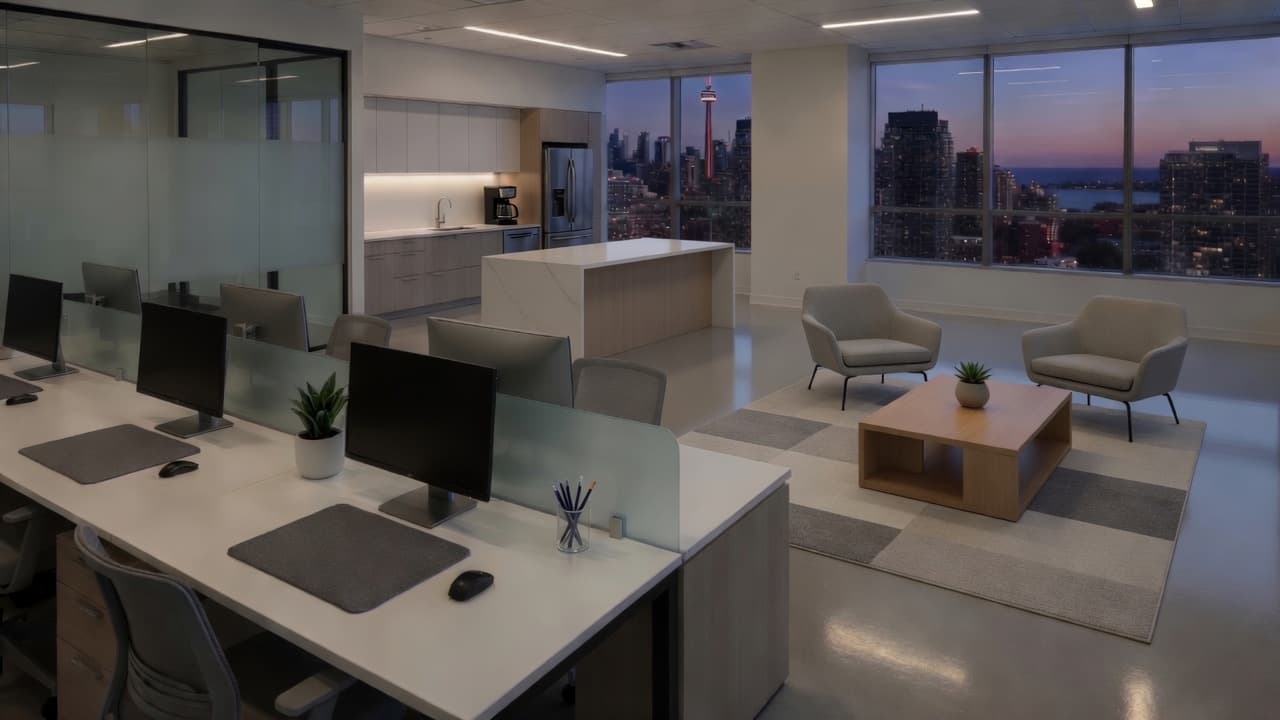
Coworking Space Cleaning Services in Toronto & the GTA
Coworking space cleaning in Toronto is a different job from cleaning a single-company office. A coworking floor is part office, part café and part event venue: dozens of members rotate through the same hot desks, phone booths and meeting rooms every day, the shared kitchen runs like a small coffee bar, and the lounge may host a 60-person event on a Tuesday night. Pro City Maids provides coworking and shared office cleaning across Toronto and the GTA, with after-hours visits, zone-based schedules and event turnovers built around how flexible workspaces actually run, not around a standard office cleaning checklist.
Quick answer
Need a coworking cleaning program in Toronto or the GTA?
No long lock-in contracts • After-hours & event turnovers • 647-691-6911
Who Needs Coworking Space Cleaning Services
This guide is for coworking operators, community and operations managers at flexible workspaces, landlords who run their own shared-office floors, and companies that sublet desks inside their own offices across Toronto, Mississauga, Vaughan, Markham, Richmond Hill and the rest of the GTA. It covers staffed coworking floors, serviced and executive suites, and shared offices inside a single company's lease. If you run a conventional single-tenant office, our office cleaning Toronto page and office cleaning frequency guide are the better fit.
Why Coworking Space Cleaning Is Not Standard Office Cleaning
A standard office cleaning scope assumes the same 20 or 50 people sit at the same desks every day and look after their own workstation. None of that holds in a coworking space. Four differences change the whole cleaning plan:
- Nobody owns the desk. A hot desk, a phone booth or a four-person meeting room is used by different members every day, often several in one day. In a normal office, one person's keyboard is one person's germs; in a coworking space every touch surface is shared.
- The kitchen is a hospitality space. Free coffee, a shared fridge and a dishwasher that runs twice a day mean the kitchen gets café-level traffic. It is the zone members judge a space by, and the first one to look neglected.
- The space is part of the product. Coworking operators sell memberships on how the space looks and feels during a tour. A tired washroom or a sticky booth table costs sales, not just comfort.
- The schedule is irregular. Evening events, weekend day passes and early-morning members shrink the after-hours cleaning window and move it around week to week.
Base-Building Janitorial vs. Operator Cleaning: Who Cleans What?
This is the question most coworking space cleaning content skips, and it is where operators most often overpay or leave gaps. Many coworking spaces in the GTA sit inside a leased office building, and many office leases include some form of base-building janitorial service provided by the landlord's contractor. What that covers depends on your lease, but the typical split looks like this:
- Usually the landlord's contractor: the main lobby, elevators and elevator lobbies, stairwells, base-building washrooms on shared floors, exterior entrances, and sometimes a standard nightly office pass inside the suite (vacuuming, garbage and a light dusting).
- Usually the operator's responsibility: anything above the standard office specification, which in a coworking space is most of the work: hot desk and phone booth disinfection, kitchen and coffee station cleaning, dishwashing, event turnovers, in-suite washrooms and showers, glass partitions, and mid-day touch-ups.
- Often unclear until it goes wrong: recycling and organics streams, carpet extraction, interior glass, and who restocks consumables inside the suite.
Before you request quotes, pull the cleaning schedule attached to your lease and mark what the landlord already does and how often. Pro City Maids then quotes only the gap, and coordinates with the building's contractor so two crews are not vacuuming the same floor on the same night. For operators on their own floor with no base-building service, we quote the full scope, and our contract janitorial services cover the building-level work as well.
How Often Each Coworking Zone Should Be Cleaned
Frequency should follow member traffic and how many different people touch a surface, not square footage. A zone-based schedule is the single biggest difference between a coworking space cleaning program and a generic office contract:
| Zone | Daily (after hours) | Mid-day pass | Weekly or monthly |
|---|---|---|---|
| Hot desks & open seating | Disinfect desk tops, chair arms, monitor arms and shared peripherals | Not usually needed | Chair upholstery and cable trays, monthly |
| Phone booths & pods | Disinfect table, seat, door handle and light switch; empty bin | At high occupancy | Vacuum acoustic panels and vent grilles, weekly |
| Meeting rooms | Tables, chairs, whiteboard, remotes, conference phone and screen bezel | Reset between bookings if staffed on site | Glass walls and interior windows, weekly |
| Kitchen & coffee station | Counters, sinks, appliance fronts, tables, floors; load dishwasher | Yes, once the space is over roughly half full | Fridge clear-out and interior wipe, weekly |
| Washrooms & showers | Full clean and disinfection, restock | Yes, touch-up and restock | Grout and shower drains, monthly |
| Reception, lounge & event space | Front desk, entrance glass, soft seating, floors | Entrance floor in winter | Carpet and rug extraction, quarterly |
A small serviced-office suite with mostly private offices and a light kitchen can often run on three visits a week. A busy open-plan coworking floor with 100+ members almost always needs daily cleaning plus a mid-day pass. For how that compares with conventional offices, see our office cleaning frequency guide for Toronto and the GTA.
Zone-by-Zone Coworking Cleaning Checklist
Hot Desks & Open Workspace
- Desk tops cleared of member-left clutter into a lost-and-found tray, then disinfected
- Chair arms, height levers and headrests
- Shared monitors, docking stations and monitor arms with electronics-safe wipes
- Power outlets, desk grommets and lamp switches
- Floors vacuumed or mopped, including under the desk rows
Phone Booths, Pods & Meeting Rooms
- Booth tables, seats, door handles, light and fan switches
- Conference phones, screen remotes, HDMI and USB-C adapters
- Whiteboards wiped and markers and erasers set back out
- Glass partitions and door glass, handprint-free
- Chairs pushed in and the room reset to its standard layout
Shared Kitchen & Coffee Station
- Counters, sink, faucet and backsplash
- Coffee machine exterior, drip tray, grinder surround and milk fridge handle
- Microwave interior and exterior, kettle and toaster exteriors
- Dishwasher loaded or unloaded to the operator's routine
- Weekly shared-fridge clear-out on the day the operator announces to members
- Garbage, recycling and organics sorted to the building's streams
Washrooms, Showers & Wellness Rooms
- Toilets, urinals, sinks, faucets, mirrors and partitions
- Showers, drains and bench surfaces for bike commuters
- Wellness or nursing room surfaces, seating and door handles
- Soap, paper towel and toilet paper restocked
Reception, Lounge & Entrance
- Front desk, visitor sign-in tablet and card reader
- Mail and package shelves dusted
- Lounge soft seating vacuumed and cushions reset
- Entrance glass, door push plates and floor mats
Event Nights, Day Passes and Turnover Cleaning
Community events are how many Toronto coworking spaces fill desks: founder meetups, workshops, launch parties and after-hours networking. Every one of them leaves the space in a state members should not walk into at 8am. Event turnover is its own cleaning job, and it needs planning:
- Start time follows the event, not a fixed hour. We schedule the visit to begin once the event wraps, so the crew is not cleaning around guests.
- A floor plan for the reset. If you give us a photo or plan of the standard layout, we put tables, chairs and lounge furniture back where members expect them.
- Catering and bottle waste handled properly. Food waste, cans, bottles and cardboard are separated into your building's organics, recycling and garbage streams, not bagged together.
- Spills treated the same night. Wine or coffee on carpet and upholstery is far easier to lift before it sets overnight.
- Weekend day-pass traffic gets a Sunday evening or early Monday visit, so Monday members do not inherit the weekend.
Disinfectants, DINs and the New Biocides Regulations
In a shared workspace, disinfection matters more than in a private office, because the same keyboard or booth table is touched by many different people. Two practical points decide whether it actually works: the product has to be an authorized disinfectant, and it has to stay wet on the surface for the full contact time on the label. A quick spray-and-wipe on a hot desk usually removes it well before that time is up.
There is also a regulatory change operators should know about. Health Canada's Biocides Regulations came into force on May 31, 2025, and hard-surface disinfectants that carried a Drug Identification Number (DIN) are moving to a market authorization under those regulations over a multi-year transition. Health Canada's transition guidance says a transitioned disinfectant keeps the same 8-digit number, and products authorized under the old rules can continue to be sold during the transition. For an operator the practical check is unchanged: ask your cleaning company which products it uses and look for the 8-digit number on the label.
Pro tip from our commercial teams
For the wider disinfection routine, including cold and flu season, see our flu-season office disinfection guide.
Coworking Space Cleaning Across the GTA
Flexible workspace in the GTA is no longer only a downtown product. Coworking floors cluster in the downtown core, King West and Liberty Village, where members are startups, agencies and remote workers, but suburban flex space has grown around transit and highway hubs where people want a desk closer to home: the Vaughan Metropolitan Centre, the Markham tech corridor and Mississauga City Centre. Those locations clean differently:
- Downtown towers usually mean base-building janitorial, loading-dock and elevator booking rules, and security sign-in for after-hours crews, so the scope is often a top-up rather than a full clean.
- Suburban flex spaces are more often in low-rise or mixed-use buildings where the operator handles everything, with longer hours for commuters and more parking-lot slush tracked in during winter.
- Winter road salt is a real cost everywhere in the GTA: white salt residue on entrance flooring and lounge rugs needs more frequent entrance mopping from December to March to protect floors and prevent slips.
We serve coworking and shared office spaces in Toronto, Mississauga, Vaughan, Markham, Richmond Hill and Brampton.
How Coworking Space Cleaning Is Priced
Coworking space cleaning is usually priced as a monthly program rather than per visit, and the price depends on a few things that matter more here than in a standard office:
- Visit frequency, including whether a mid-day pass is needed.
- Number of washrooms, showers and kitchens, which take more time than open floor.
- How much the landlord already covers, since a top-up over base-building janitorial costs less than a full scope.
- Event frequency, quoted as a per-event turnover rate or folded into the monthly program.
- Floor types, since carpet extraction and hard-floor care are on different cycles.
Pro City Maids commercial cleaning quotes start from $280, with the exact monthly price built from a free walkthrough of your space, not a flat rate card. For general market ranges on office cleaning, see our commercial office cleaning cost guide for Toronto.
What to Ask Before Hiring a Coworking Cleaning Company
- Can you work around our events and early members? Look for a company that schedules around your calendar, not a fixed nightly slot.
- How do you handle keys, fobs and locked private offices? Pro City Maids signs credentials out to the assigned team, logs them and never duplicates them.
- Are you insured, and can you give our landlord proof? Our teams are vetted, bonded and covered by $2M+ commercial liability insurance, with proof of insurance provided on request.
- Will we see the same crew? Consistency matters in a space where members notice changes, and a regular team learns your layout and your members' habits.
- Are we locked in? Pro City Maids does not use long lock-in contracts, so scope and frequency can change as membership grows or a floor is added. See our janitorial contracts guide for what a fair agreement looks like.
Frequently Asked Questions
How often should a coworking space in Toronto be cleaned?
Most staffed coworking spaces in Toronto need a full cleaning visit every business day, usually after hours, plus a short mid-day pass on the shared kitchen and washrooms once membership fills past roughly half of the desks. Hot desks and shared meeting rooms get touched by different people every day, so a weekly or bi-weekly office schedule that works for a single-tenant office leaves a coworking space visibly behind by midweek. Pro City Maids sets the frequency per zone during a free walkthrough rather than applying one flat schedule to the whole floor.
Does the building landlord already clean our coworking space?
Sometimes partly. Many GTA office leases include base-building janitorial, where the landlord's contractor cleans the lobby, elevators, base-building washrooms and often a standard office-level pass of the leased suite. That base spec is written for a conventional office, not for a space with dozens of rotating members, a busy café-style kitchen and evening events. Check the cleaning schedule attached to your lease, then have Pro City Maids quote only the gap so you are not paying twice for the same floors.
Can you clean after an evening event and have the space ready by morning?
Yes. Event turnover is one of the main reasons coworking operators in Toronto hire a separate cleaning company. We schedule the visit to start after your event wraps, reset chairs and tables to your standard layout if you give us a floor plan, clear catering waste and recycling, clean the kitchen and washrooms, and leave the floor ready for members arriving the next morning. Book the event date with us in advance and we add it to the regular schedule.
Do you clean private offices that members lock?
Only with the operator's permission and a clear access rule. Most coworking operators either give us access to empty private offices on a set day, or exclude locked offices entirely and let members request cleaning. We follow whatever the operator's membership agreement says, sign keys and fobs out to the assigned team, log them, and never duplicate them. We do not move members' papers or devices on a desk; we clean around them.
What disinfectant do you use on hot desks and phone booths?
Health Canada authorized hard-surface disinfectants, applied for the full contact time printed on the label, with electronics-safe wipes for keyboards, headsets and monitors so liquid never runs into equipment. Health Canada's Biocides Regulations came into force on May 31, 2025 and disinfectants are moving from a Drug Identification Number (DIN) to a market authorization under those rules, keeping the same 8-digit number. Either way, the number on the label is what an operator can check.
Who supplies paper towel, soap and coffee station supplies?
Our teams bring professional equipment and cleaning products, with eco-friendly options available on request. Consumables like paper towel, toilet paper and hand soap are typically supplied by the operator and restocked by us, or we can quote supply management into the program. Coffee, milk and snacks stay with the operator's hospitality team; we clean the coffee station, wipe the machines' exteriors and empty drip trays.
Do you clean coworking spaces outside downtown Toronto?
Yes. Pro City Maids cleans shared offices and flexible workspaces across the GTA, including Mississauga, Vaughan, Markham, Richmond Hill and Brampton, and one account contact can cover every location if an operator runs more than one site. Suburban coworking spaces often have longer opening hours for commuters, so we schedule cleaning around the actual quietest window at each site rather than a single company-wide time.